"He's not fat, he's fluffy."
I said those exact words about my Golden Retriever for two years. Then my vet looked at me and said, "No, he's not. He's obese."
The scale said 85 pounds. But the number alone didn't tell the whole story. What mattered was what I could feel — or rather, what I couldn't feel. When I ran my hands along his sides, I couldn't feel his ribs without pressing hard. When I looked at him from above, there was no waist. Just one continuous curve.
That's when I learned about the Body Condition Score (BCS) — a 9-point system that vets use to assess whether a dog is at a healthy weight. It's not about the number on the scale. It's about what you can see and touch.
And it changed everything.
If you've ever wondered whether your dog is at a healthy weight, you're in the right place. This guide will show you exactly how to use the BCS system at home — with visual examples for every score from 1 to 9.
But first, let me show you why the scale is lying to you...
Why Body Condition Score Matters More Than Weight
Stepping on a scale tells you a number, but it doesn't tell you whether that number is healthy. A muscular German Shepherd and an overweight French Bulldog might both weigh 30 kg, but their health status is completely different.
That's why veterinarians worldwide use the Body Condition Score (BCS) — a standardized 9-point scale that assesses fat coverage directly, regardless of breed or frame size. It was developed by Dr. Dottie Laflamme in 1997 and adopted by the World Small Animal Veterinary Association (WSAVA) as the international standard.
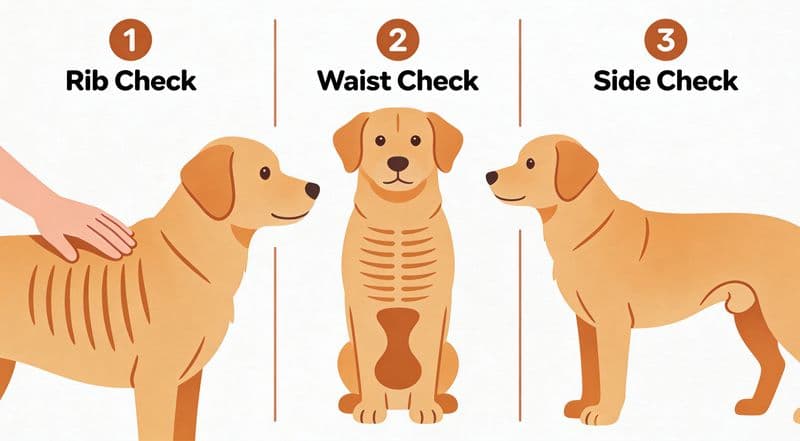
The Three-Step Home Check
You don't need any equipment to check your dog's BCS. Just your hands and eyes:
Step 1: Rib Check — Run your hands flat along both sides of your dog's ribcage. Use the pressure you'd use to smooth a wrinkled shirt. Can you feel the ribs easily? You should be able to feel them with light pressure at ideal weight.
Step 2: Waist Check — Stand directly above your dog and look down at their body shape. Behind the ribcage, the body should narrow before the hips. If the body is a straight line or bulges outward, your dog may be overweight.
Step 3: Side Profile Check — Look at your dog from the side at their eye level. The belly should tuck up from the chest toward the hind legs. A sagging or level belly suggests excess weight.
Try our interactive BCS assessment — it walks you through these three steps and gives you a score in under 2 minutes.
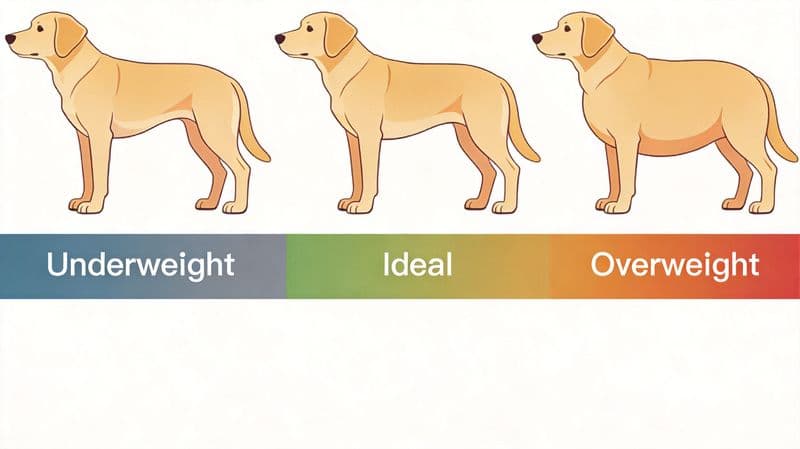
The 9-Point BCS Scale Explained
Here is what each score looks and feels like, with the three key observations veterinarians use:
BCS 1–3: Underweight
| Score | Ribs | Waist (from above) | Belly (from the side) |
|---|---|---|---|
| 1 — Emaciated | Visible from a distance, no fat cover | Severe hourglass | Severe tuck, abdomen looks empty |
| 2 — Very Thin | Easily visible, minimal fat | Pronounced hourglass | Obvious tuck |
| 3 — Thin | Visible but with slight fat covering | Clear waist | Noticeable tuck |
What to do: If your dog scores 1–3, consult your veterinarian. Underweight dogs may have underlying health conditions, parasites, or nutritional deficiencies that need medical attention — not just more food.
BCS 4–5: Ideal
| Score | Ribs | Waist (from above) | Belly (from the side) |
|---|---|---|---|
| 4 — Underweight side of ideal | Easily felt with minimal fat | Visible waist | Abdominal tuck present |
| 5 — Ideal | Easily felt with light pressure | Clear waist behind ribs | Moderate abdominal tuck |
This is the target. At BCS 5, your dog has the right amount of fat coverage — enough to be healthy, but not so much that it strains joints, organs, or metabolism. Dogs at ideal BCS live on average nearly 2 years longer than overweight dogs, according to a landmark Purina lifetime study.
BCS 6–9: Overweight to Obese
| Score | Ribs | Waist (from above) | Belly (from the side) |
|---|---|---|---|
| 6 — Overweight | Felt with moderate pressure | Waist barely visible | Slight abdominal tuck |
| 7 — Heavy | Difficult to feel under fat | No visible waist | Belly hangs slightly |
| 8 — Obese | Very difficult to feel | No waist, body is oval | Belly hangs noticeably |
| 9 — Severely Obese | Cannot be felt at all | Body wider than chest | Pendulous belly, fat deposits visible |
What to do: If your dog scores 6 or above, it's time to act. Each point above 5 represents roughly 10–15% excess body weight. Start with our free BCS assessment tool and then use the calorie calculator to determine the right daily intake for weight loss.
How BCS Relates to Calorie Needs
Your dog's BCS directly affects their calorie requirements:
| BCS | Adjustment |
|---|---|
| 1–3 (Underweight) | Feed 1.2–1.8× RER for weight gain |
| 4–5 (Ideal) | Feed 1.4–1.8× RER for maintenance |
| 6–7 (Overweight) | Feed 0.8–1.0× RER for gradual weight loss |
| 8–9 (Obese) | Feed 0.6–0.8× RER under veterinary supervision |
Never crash-diet an obese dog. Rapid weight loss can cause hepatic lipidosis — a dangerous liver condition. Aim for 1–2% body weight loss per week.
Calculate your dog's exact calorie needs →
Tools to Assess Your Dog
- BCS Assessment — Our free 2-minute tool that walks you through the rib, waist, and belly check
- Calorie Calculator — Personalized daily calorie target based on weight, age, and activity
- Feeding Plan — Exact portion sizes for your dog's specific food brand
- Breed Weight Charts — Ideal weight ranges for 150+ breeds with calorie estimates