The Single Number That Determines Your Dog's Weight
Every dog has a specific calorie target — feed above it, and your dog gains weight. Feed below it, and your dog loses weight. Feed exactly at it, and your dog maintains.
It sounds simple, but most owners guess. And they guess wrong — 59% of dogs are overweight, according to the Association for Pet Obesity Prevention.
This guide explains the veterinary formula behind calorie calculations so you can stop guessing and start feeding the right amount.
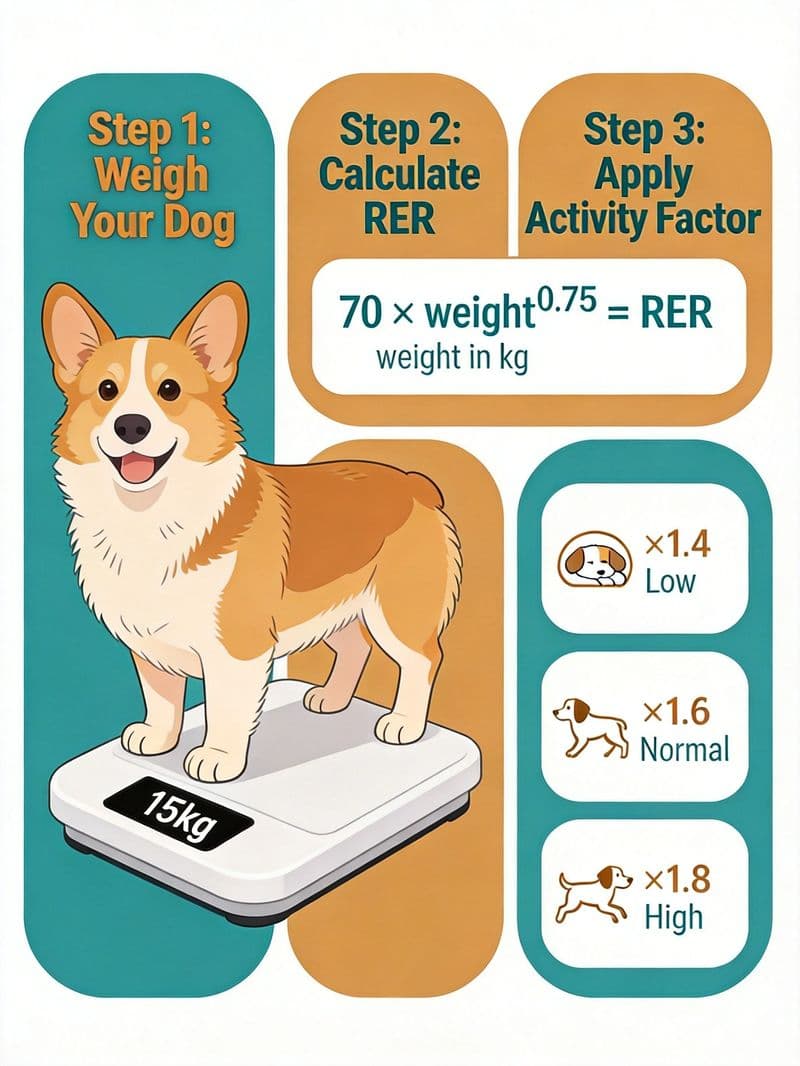
Step 1: Calculate Resting Energy Requirement (RER)
RER is the number of calories your dog needs at complete rest — just to keep the heart beating, lungs breathing, and organs functioning. Think of it as your dog's baseline metabolism.
The formula:
RER (kcal/day) = 70 × (body weight in kg)^0.75
Examples:
| Weight | RER |
|---|---|
| 5 kg (11 lbs) | 234 kcal |
| 10 kg (22 lbs) | 394 kcal |
| 15 kg (33 lbs) | 534 kcal |
| 25 kg (55 lbs) | 783 kcal |
| 30 kg (66 lbs) | 897 kcal |
| 40 kg (88 lbs) | 1,114 kcal |
Don't want to do the math? Use our free calorie calculator — it does it instantly.
Step 2: Apply the Life Stage Multiplier
Puppies, adults, and seniors have different calorie needs relative to their RER. This is called the Daily Energy Requirement (DER) multiplier.
| Life Stage | Multiplier | Example (15 kg dog) |
|---|---|---|
| Puppy — growth | 2.0–3.0× RER | 1,068–1,602 kcal |
| Adult — maintenance | 1.4–2.0× RER | 748–1,068 kcal |
| Senior — reduced activity | 1.2–1.4× RER | 641–748 kcal |
Puppies need more because they're building bone, muscle, and tissue. Seniors need less because metabolism slows and activity typically decreases.
Step 3: Factor in Activity Level
Within each life stage, activity level further adjusts calorie needs:
| Activity Level | Description | Multiplier |
|---|---|---|
| Inactive | Mostly rests, short potty walks | ×0.8 |
| Moderate | Regular daily walks and play | ×1.0 |
| Active | Long walks, runs, dog sports | ×1.2 |
| Very Active | Working dog, herding, agility | ×1.4 |
A couch potato Labrador needs significantly fewer calories than a field-trial Labrador of the same weight.
Step 4: Adjust for Neuter Status
Neutering and spaying reduce metabolic rate by about 20–25% because sex hormones help maintain muscle mass and metabolic activity.
| Status | Adjustment |
|---|---|
| Intact (not neutered) | No adjustment — use standard multipliers |
| Neutered/Spayed | Multiply by 0.8 |
This is one of the most commonly missed adjustments. If your dog was neutered and you didn't reduce calories, that alone could explain gradual weight gain.
Putting It All Together: A Real Example
Let's calculate daily calories for Max, a 25 kg neutered adult Labrador with moderate activity:
- RER = 70 × 25^0.75 = 783 kcal/day
- Life stage multiplier (adult) = 1.6
- Activity multiplier (moderate) = 1.0
- Neuter adjustment = 0.8
DER = 783 × 1.6 × 1.0 × 0.8 = 1,002 kcal/day
Max needs approximately 1,002 calories per day to maintain his weight. To lose weight, reduce by 15–25% → 750–850 kcal/day.
Try it yourself with our calorie calculator →
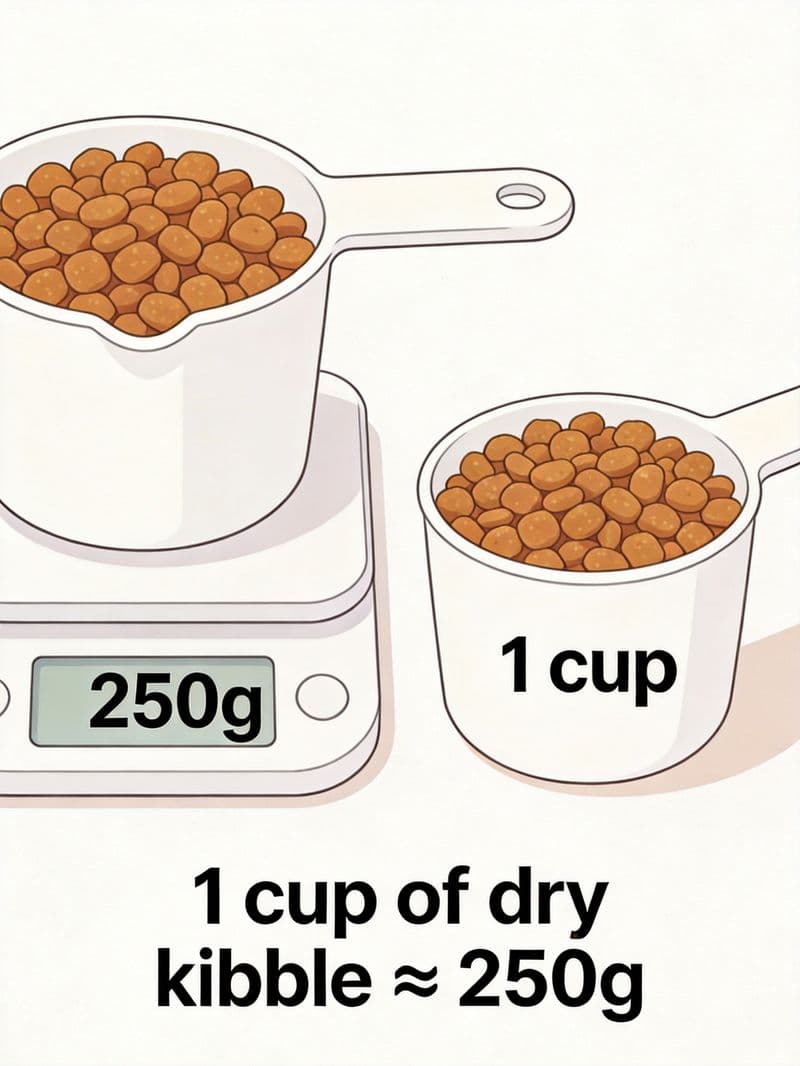
How This Translates to Food
Knowing the calorie number is only half the battle. You also need to know how many calories are in your dog's food.
Most dry dog foods contain 300–400 kcal per cup and 3,000–4,000 kcal per kg. But the range is wide — some high-calorie foods are over 500 kcal/cup, while weight management formulas may be as low as 250 kcal/cup.
Always check the calorie content on the bag, not just the feeding guidelines. Feeding guidelines are generic estimates and often overestimate for neutered, less-active dogs.
Use our feeding calculator to get personalized portion recommendations based on your dog's specific food brand.
Red Flags in Calorie Calculations
"The bag says to feed 3 cups, but my dog is gaining weight." Feeding guidelines on pet food bags are based on intact, moderately active dogs. If your dog is neutered or less active, they need 15–30% less than the bag recommends.
"I switched to a 'weight management' food but my dog isn't losing." Weight management foods are lower in calories per cup, but if you feed the same volume, the calorie reduction may be minimal. Always calculate by calories, not by cups.
"My dog is always hungry." Some dogs are food-motivated regardless of actual hunger. Splitting daily calories into 2–3 meals, using slow feeder bowls, and adding water to kibble can help manage the perception of hunger without adding calories.
Common Calorie Mistakes
- Forgetting treats: Treats should be no more than 10% of daily calories. A single large biscuit can be 100+ kcal.
- Not measuring: Eyeballing portions leads to gradual overfeeding. Use a measuring cup or kitchen scale.
- Inconsistent feeding: Different family members feeding at different times makes tracking impossible. Agree on one person to measure and feed.
- Ignoring seasonal changes: Dogs are less active in winter — reduce calories accordingly.
Quick Reference Table
| Dog Weight | Inactive Neutered | Moderate Neutered | Active Intact |
|---|---|---|---|
| 5 kg | 260 kcal | 325 kcal | 455 kcal |
| 10 kg | 440 kcal | 550 kcal | 770 kcal |
| 15 kg | 600 kcal | 750 kcal | 1,050 kcal |
| 25 kg | 880 kcal | 1,100 kcal | 1,540 kcal |
| 35 kg | 1,130 kcal | 1,410 kcal | 1,980 kcal |
| 45 kg | 1,370 kcal | 1,710 kcal | 2,400 kcal |
These are estimates. For exact numbers, use our calorie calculator with your dog's specific details.
Next Steps
- Calculate your dog's exact calorie needs — free, personalized
- Get a feeding plan with portion sizes — based on your dog's food brand
- Check if your dog is at a healthy weight — 2-minute BCS assessment