I pressed my hand against my dog's side and couldn't feel a single rib.
It wasn't until that moment — standing in my living room, hands on my best friend's body — that I realized I had no idea what a healthy dog was supposed to feel like.
His name is Max. He's a 4-year-old Labrador, and I'd been telling myself he was "just a big guy." My friends said the same thing. "He's handsome! He's solid!" Even my vet had mentioned it in passing, but I brushed it off.
Then I tried the Body Condition Score test — a simple 9-point assessment vets use to determine if a dog is at a healthy weight. The results were brutal.
Max was a 7 out of 9. Solidly overweight.
Here's what hit me hardest: 59% of dogs in the U.S. are classified as overweight or obese. That's not a rare condition. That's the majority. And most owners — like me — have no idea until they actually check.
If you're reading this, you might be in the same boat. So let's figure it out together, starting with one simple question: Can you feel your dog's ribs?
The Number Most Dog Owners Miss
Here's a statistic that should worry every dog owner: 59% of dogs are classified as overweight or obese, according to the Association for Pet Obesity Prevention (APOP). Yet in surveys, the vast majority of dog owners — over 80% — believe their dog is at a healthy weight.
That gap isn't because owners don't care. It's because most people simply can't tell when their dog is carrying too much weight. The change is gradual, and since we see our dogs every day, we don't notice the slow creep.
This is exactly why veterinarians use a standardized tool called the Body Condition Score (BCS) — and why you should learn to use it too.
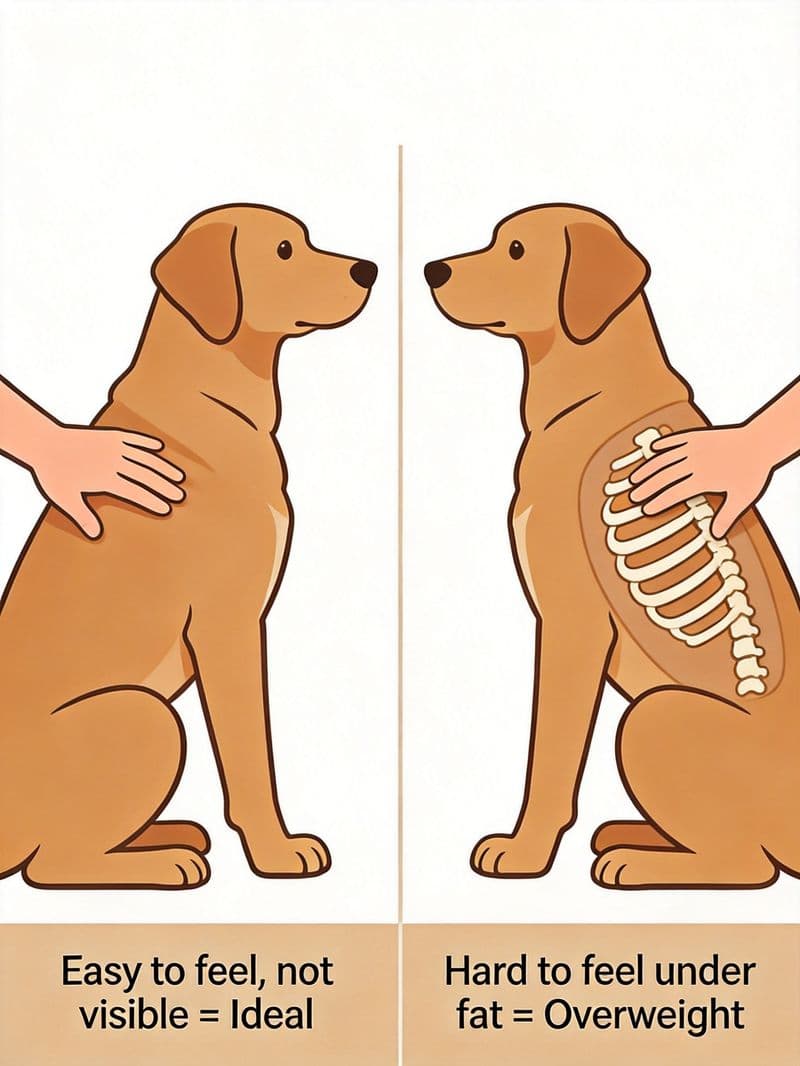
What Is a Body Condition Score?
A Body Condition Score is a 1–9 scale that evaluates your dog's body fat based on look and feel. It was developed by veterinary nutrition experts and is endorsed by the World Small Animal Veterinary Association (WSAVA) as the gold standard for assessing canine body condition.
| Score | Category | What You See |
|---|---|---|
| 1–3 | Underweight | Ribs, spine, and hip bones clearly visible. Obvious waist and abdominal tuck. |
| 4–5 | Ideal | Ribs easily felt with slight fat cover. Visible waist from above. Abdominal tuck from the side. |
| 6–7 | Overweight | Ribs difficult to feel. Waist barely visible. Rounded abdomen. |
| 8–9 | Obese | Ribs not palpable under fat. No visible waist. Distended abdomen. Fat deposits on neck and base of tail. |
A score of 4 or 5 is ideal. Anything above 5 means your dog is carrying excess weight.
The 3-Point Self-Check You Can Do at Home
You don't need special equipment. Here's how to check your dog's BCS in about 2 minutes:
1. Feel the Ribs
Run your hands along your dog's ribcage with moderate pressure.
- Ideal: You can feel each rib easily, with a thin layer of fat — similar to how the back of your hand feels when you press gently.
- Overweight: You have to press firmly to find the ribs, or can't feel them at all.
- Underweight: The ribs are visibly protruding with no fat covering.
2. Look from Above
Stand directly over your dog and look down at their body shape.
- Ideal: There's a clear inward curve (waist) behind the ribs, creating a visible hourglass shape.
- Overweight: The waist is barely visible or completely absent — the body looks like a straight tube or even bulges outward.
- Underweight: The waist is extremely pronounced, with visible hip bones.
3. Look from the Side
View your dog from the side at their level.
- Ideal: The abdomen tucks upward from the ribcage toward the hind legs — a smooth upward slant.
- Overweight: The abdomen hangs level with or below the ribcage, with little or no tuck.
- Underweight: The abdominal tuck is extreme, creating a severe upward sweep.
Why This Matters More Than You Think
Extra weight isn't just a cosmetic issue. Research published in the Journal of Veterinary Internal Medicine found that dogs maintained at an ideal body weight lived nearly 2 years longer than their overweight littermates.
The health risks of excess weight in dogs are significant and well-documented:
- Joint problems and arthritis — extra weight puts mechanical stress on joints, accelerating cartilage breakdown
- Diabetes mellitus — obese dogs are 2–3 times more likely to develop diabetes
- Heart and respiratory disease — excess fat compresses the chest cavity, making breathing harder
- Reduced immune function — obesity impairs white blood cell function
- Shorter lifespan — the Purina Lifespan Study showed a median difference of nearly 2 years
- Heat intolerance — fat acts as insulation, making overweight dogs vulnerable to heatstroke
What to Do If Your Dog Is Overweight
If your self-check suggests your dog is above ideal, don't panic — but do take action. Here's the proven approach:
Step 1: Get a Professional Baseline
Schedule a vet visit to rule out medical causes (hypothyroidism, Cushing's disease) and establish a target weight. Your vet can also help you calculate exact daily calorie needs.
Step 2: Calculate Exact Calorie Needs
One of the biggest mistakes owners make is following the feeding guidelines on dog food packaging. Those are general ranges, not personalized recommendations. Your dog's actual calorie needs depend on their current weight, target weight, age, activity level, and whether they're spayed or neutered.
Try our free Calorie Calculator to get your dog's exact daily requirement based on veterinary RER/DER formulas.
Step 3: Create a Structured Feeding Plan
Free-feeding (leaving food out all day) is one of the fastest paths to obesity. Switch to measured meals at set times. A Feeding Plan converts your dog's calorie target into exact portion sizes in cups or grams, making it easy to stick to.
Step 4: Track Progress Weekly
Weight loss in dogs should be gradual — about 1–2% of body weight per week. Any faster can be dangerous. Use a Weight Tracker to log weekly weigh-ins and see if you're on track.
A Note on Slow Feeders
If your dog eats too fast — a common issue that leads to overeating because the brain hasn't registered fullness — a slow feeder bowl can help. These bowls have ridges and mazes that force dogs to eat more slowly, which aids digestion and reduces the risk of bloat.
For medium and large dogs, a spiral-maze bowl like the JASGOOD Slow Feeder Bowl is a practical pick — around 3 cups of capacity, and easy for most dogs to figure out while still slowing them down.
Quick Reference: The BCS at a Glance
| Check | Ideal (4-5) | Overweight (6-7) | Obese (8-9) |
|---|---|---|---|
| Ribs | Easy to feel | Hard to feel | Can't feel |
| Waist (above) | Visible hourglass | Barely visible | No waist |
| Belly (side) | Tucks up | Slight tuck | Hangs down |
| Overall | Fit and toned | Rounded | Very rounded |
Take the Full Assessment
The self-check above gives you a rough idea, but for a more precise evaluation, try our free BCS Assessment Tool. It asks 4 simple questions based on WSAVA standards and gives you a personalized score with recommendations.
👉 Start Free BCS Assessment — takes 2 minutes, no account needed
Frequently Asked Questions
How often should I check my dog's BCS?
Every 2–4 weeks for adult dogs. Puppies and senior dogs should be checked more frequently — weekly during growth phases and monthly for seniors. Any dog on a weight management plan should be checked weekly.
My vet said my dog's BCS is 6. Is that bad?
A BCS of 6 means your dog is mildly overweight — roughly 10–15% above ideal body weight. It's very common and very manageable with diet adjustments. The key is to address it now before it progresses to 7 or higher.
Can a dog be naturally "chunky"?
No breed is naturally overweight. Some breeds (Bulldogs, Pugs, Basset Hounds) have stocky builds that can make them look heavier, but their BCS should still be 4–5. The fat covering the ribs should still be thin enough to feel them easily.
What's the difference between BCS 5 and BCS 6?
It can be subtle. At BCS 5, you can feel the ribs with light pressure and see a clear waist. At BCS 6, you need moderate pressure to feel the ribs, and the waist is just barely visible from above. If you're unsure, it's better to have your vet evaluate.