Quick Answer: What Size Crate for Your Dog?
Rule of thumb: Crate length should be dog's body length + 3-4 inches.
| Size | Weight | Crate Length | Popular Breeds |
|---|---|---|---|
| Small (S) | Under 20 lbs (9 kg) | 24" | French Bulldog, Beagle |
| Medium (M) | 20–40 lbs (9–18 kg) | 30" | Border Collie, Cocker Spaniel |
| Large (L) | 40–70 lbs (18–32 kg) | 36" | Labrador, Golden Retriever |
| XL | 70–90 lbs (32–41 kg) | 42" | German Shepherd |
| XXL | Over 90 lbs (41+ kg) | 46–54" | Great Dane, St. Bernard |
👉 Find the exact crate for your dog: Crate Size Calculator
Data source: AKC breed standards + veterinary crate fitting guidelines
🎯 Want exact data for your dog? Use the Crate Size Calculator — enter your dog's breed and weight to get a personalized crate recommendation.
Why Crate Size Matters More Than You Think
A crate that's too small is cruel — your dog can't stand up, turn around, or lie down comfortably. But a crate that's too big is almost as bad. If there's too much space, your dog may use one end as a bedroom and the other as a bathroom, which completely undermines house training.
The right crate is just large enough for your dog to:
- Stand up without their head touching the top
- Turn around comfortably
- Lie down fully stretched out on their side
That's it. Any bigger defeats the purpose. Any smaller is inhumane.
Dog Crate Size Chart by Breed Category
How to Measure
If your dog is fully grown, measure from the tip of the nose to the base of the tail (not the tip) while standing. Add 2–4 inches. That's your minimum crate length. For height, measure from the floor to the top of the head while sitting, and add 2–4 inches.
Toy Breeds (Under 12 lbs)
| Breed | Weight (lbs) | Crate Size | Example |
|---|---|---|---|
| Chihuahua | 3–6 | 18" | 18" crate |
| Pomeranian | 3–7 | 18" | 18" crate |
| Yorkie | 4–7 | 18" | 18" crate |
| Maltese | 4–7 | 18" | 18" crate |
| Shih Tzu | 9–16 | 22" | 22" crate |
Small Breeds (12–25 lbs)
| Breed | Weight (lbs) | Crate Size | Example |
|---|---|---|---|
| French Bulldog | 16–28 | 24" | 24" crate |
| Boston Terrier | 12–25 | 24" | 24" crate |
| Cavalier King Charles | 13–18 | 24" | 24" crate |
| Mini Schnauzer | 11–20 | 24" | 24" crate |
| Pug | 14–18 | 24" | 24" crate |
Medium Breeds (25–50 lbs)
| Breed | Weight (lbs) | Crate Size | Example |
|---|---|---|---|
| Beagle | 20–30 | 30" | 30" crate |
| Border Collie | 30–55 | 36" | 36" crate |
| Cocker Spaniel | 20–30 | 30" | 30" crate |
| Australian Shepherd | 40–65 | 36" | 36" crate |
| Bulldog | 40–50 | 36" | 36" crate |
Large Breeds (50–90 lbs)
| Breed | Weight (lbs) | Crate Size | Example |
|---|---|---|---|
| Labrador Retriever | 55–80 | 42" | 42" crate |
| Golden Retriever | 55–75 | 42" | 42" crate |
| German Shepherd | 50–90 | 42" | 42" crate |
| Husky | 35–60 | 36"–42" | 42" crate |
| Doberman | 60–100 | 42" | 42" crate |
Giant Breeds (90+ lbs)
| Breed | Weight (lbs) | Crate Size | Example |
|---|---|---|---|
| Great Dane | 110–175 | 48" | 48" crate |
| Saint Bernard | 120–180 | 48" | 48" crate |
| Mastiff | 120–230 | 48" | 48" crate |
| Newfoundland | 100–150 | 48" | 48" crate |
| Irish Wolfhound | 105–120 | 48" | 48" crate |
How to Measure Your Dog for a Crate
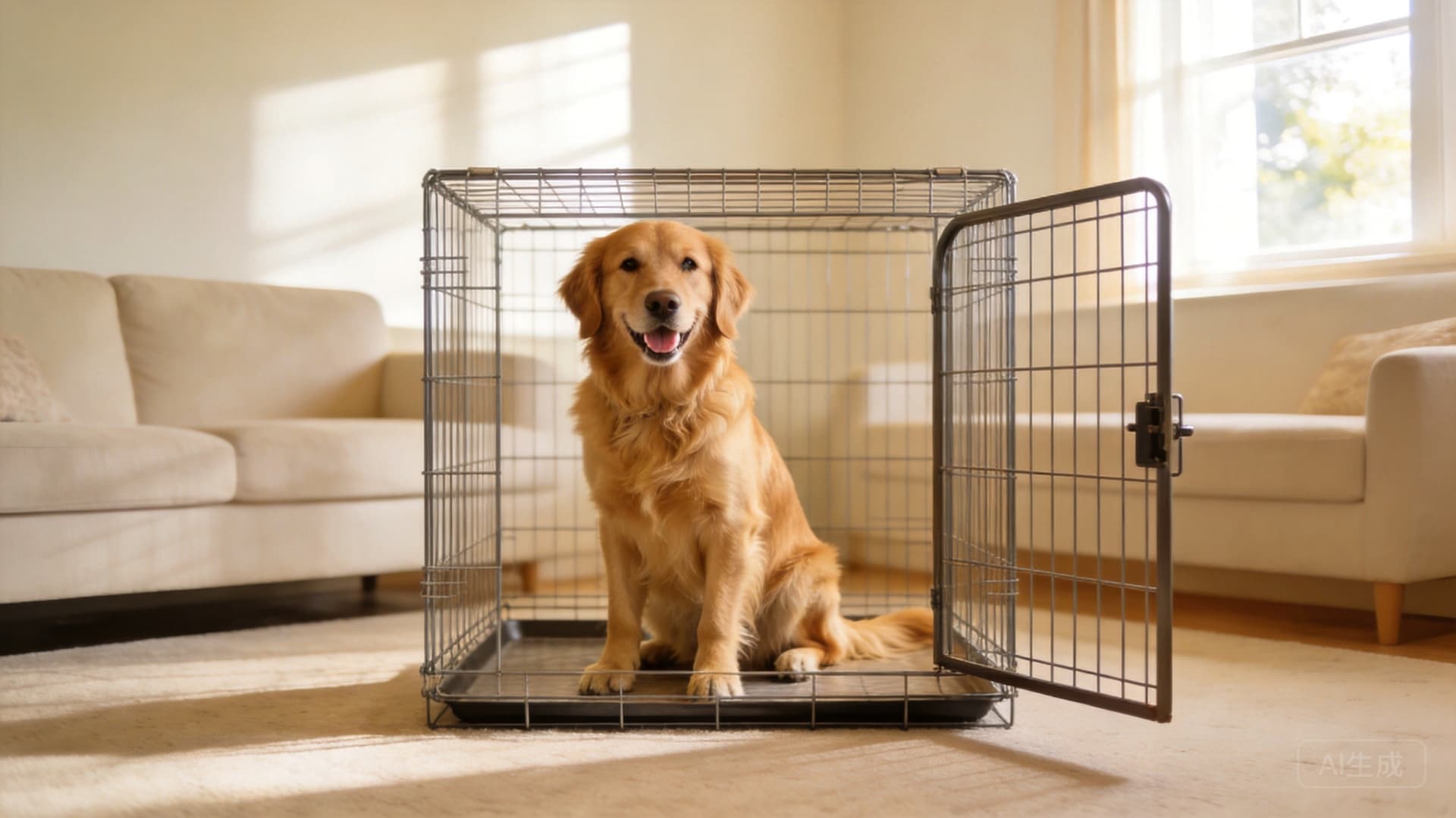
Accurate measurements prevent costly mistakes. Here's exactly what to measure:
- Length: Nose tip to tail base (not tail tip) — then add 2–4 inches
- Height: Floor to top of head while sitting — then add 2–4 inches
- Width: Shoulder to shoulder at widest point — then add 2 inches
These three numbers give you the minimum interior crate dimensions.
The Divider Panel Trick (Buy Once, Never Again)
Here's the biggest money-saving tip nobody tells new puppy owners: buy the crate sized for your dog's adult weight, not their current puppy size, and use the divider panel.
Most quality wire crates come with a removable divider. Here's how it works:
- Buy the adult-sized crate (e.g., 42" for a Golden Retriever puppy)
- Insert the divider to create a smaller space appropriate for the puppy
- Slide the divider back as the puppy grows
- Remove the divider entirely once the dog is full-grown
You buy one crate. Ever. Instead of buying a 24" crate, then a 36", then a 42" as your puppy grows — which is what most owners end up doing.
Crate Training Best Practices
A crate should never be used as punishment. Done right, it becomes your dog's safe space — their den. Here's how:
Do:
- Make it positive — feed meals inside the crate, give high-value treats for going in voluntarily
- Start slow — 5-minute sessions, gradually increase
- Use a cue — "kennel" or "crate" with a treat reward
- Cover at night — a crate cover makes it feel like a den and reduces visual stimuli
- Remove collars — collars can get caught on crate bars
Don't:
- Use it as punishment — the crate must always be a positive space
- Leave a dog crated too long — puppies can hold it roughly 1 hour per month of age (up to ~8 hours for adults)
- Force it — if your dog panics in the crate, start over with the door open and treats inside
- Use it to avoid exercise — a tired dog is a well-behaved dog; crating is not a substitute for walks
Crate vs. Other Containment Options
| Option | Best For | Cost | Pros | Cons |
|---|---|---|---|---|
| Wire crate | House training, travel | $30–80 | Good ventilation, divider panel, folds flat | Heavy, not attractive |
| Plastic crate | Car travel, airline | $25–60 | Airline approved, enclosed feel | Less ventilation, no divider |
| Soft crate | Calm dogs, shows, camping | $30–70 | Lightweight, portable | Not for chewers/diggers |
| Playpen | Play time, small spaces | $30–60 | More space, top opening | Not for unsupervised time |
Find Your Dog's Ideal Weight First
Crate sizing depends on your dog's adult weight. If you're not sure how big your puppy will get — or if your adult dog is currently overweight and you're buying a crate that fits their current size — check our breed guides first.
Browse Dog Breeds — Weight ranges and calorie needs for 150+ breeds
BCS Assessment — Check if your dog is at a healthy weight
Want Personalized Recommendations?
🐾 Every dog is different. Get breed-specific weight, feeding, and exercise recommendations tailored to your dog's age and size. → Browse 159 breed profiles on PawScale
Frequently Asked Questions
Should I buy a bigger crate "just in case"?
No. A crate that's too big defeats the purpose of crate training. Your dog should have just enough room to stand, turn, and lie down. If you want extra space, look into an exercise pen (ex-pen) attached to the crate, not a bigger crate.
Can I use a crate for a dog with separation anxiety?
Crate training can help with mild separation anxiety by providing a safe, enclosed space. But for moderate to severe separation anxiety, a crate can make things worse — some dogs will injure themselves trying to escape. Consult a veterinary behaviorist before crating an anxious dog.
What size crate for a mixed breed dog?
Measure your dog (nose-to-tail-base + 2–4 inches for length, floor-to-head-while-sitting + 2–4 inches for height) and buy accordingly. If you're buying for a mixed breed puppy and don't know the adult size, estimate based on the parents' sizes, or buy a crate with a divider panel so you can adjust as they grow.
How long can a dog stay in a crate?
Adult dogs should not be crated for more than 8 hours during the day. Puppies need much more frequent breaks — a general rule is 1 hour per month of age (a 3-month-old puppy can hold it for about 3 hours). At night, most adult dogs can go 8–9 hours. Every dog should get adequate exercise and social time outside the crate.